Audio & Headphones
Sony WH-1000XM5 Review: Still the Noise-Cancelling Benchmark
- Brand:
- Sony
- Ages:
- 13+ years
- Updated:
- 2026-07-04
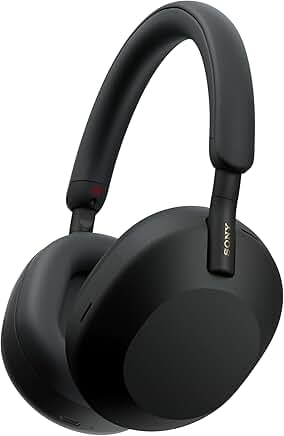
The verdict
The best all-around choice for frequent travelers and commuters who want the strongest available noise cancellation and don't mind paying a premium for it — casual listeners will get most of the same experience from cheaper options.
Pros
- Active noise cancellation remains at or near the top of the category, especially against low-frequency drone (planes, trains, AC units)
- Around 30 hours of battery life with ANC on, with fast-charge topping up several hours of playback in minutes
- Multipoint pairing keeps a laptop and phone connected simultaneously, switching audio automatically
- Genuinely comfortable for multi-hour wear thanks to soft, well-distributed clamping pressure
Cons
- No longer folds flat into a compact case the way the WH-1000XM4 did — the redesigned hinge trades pocketability for a cleaner look
- Premium price puts it well above mid-range ANC competitors that cover 80% of the same use case
- Touch controls on the ear cup are sensitive and can register accidental taps
This review is based on Sony's published specifications for the WH-1000XM5 and the consistent pattern across owner and expert coverage since launch: near-universal praise for noise cancellation and comfort, with the non-folding design as the most common point of friction versus the previous generation.
Noise cancellation is still the headline feature
Sony's ANC processing continues to lead or tie the category, particularly against steady low-frequency noise like engine drone on flights — the scenario most buyers are actually solving for. It's less effective against sudden, sharp sounds (a dog bark, a door slam), which is a physical limitation of ANC technology generally, not specific to this model.
The design trade-off buyers keep flagging
The WH-1000XM5 dropped the folding hinge of its predecessor for a single-piece headband design. It looks cleaner and arguably fits better, but the included case is bulkier as a result — worth checking if bag space is a real constraint for your travel habits.
Who it's for
Best for frequent flyers, train commuters, and open-office workers who need serious noise cancellation and will actually use multipoint pairing across a laptop and phone. If you mostly listen at home, a cheaper pair of ANC headphones will get you most of the benefit for meaningfully less money.
Frequently asked
- Can I connect two devices at once?
- Yes — multipoint Bluetooth pairing lets it stay connected to two devices simultaneously (e.g. a laptop and a phone), automatically switching audio to whichever is active.
- How long does the battery last?
- Approximately 30 hours with ANC enabled, per Sony's published specification. A short fast-charge session adds several hours of playback.
- Do they fold flat like the previous model?
- No — the WH-1000XM5 uses a single-piece, non-folding design, a deliberate change from the WH-1000XM4's folding hinge. The included case is correspondingly bulkier.
- Are the Sony WH-1000XM5 worth the price?
- Yes, for frequent travelers and commuters who will actually use the category-leading noise cancellation and multipoint pairing daily. Casual, mostly-at-home listeners can get 80% of the experience from a cheaper ANC pair and won't feel the premium is justified.
You might also like
Audio & Headphones
Soundcore Boom 2
Anker · Ages 13+ years
- IPX7 waterproof rating and a design built to float, tested reliably by independent reviewers in submersion tests
- Advertised 24-hour battery life, with independent testing measuring over 27 hours in real-world use
- Large and heavy for something marketed as a portable speaker, more suited to a car trunk or yard than a backpack
Audio & Headphones
Beam (Gen 2)
Sonos · Ages 13+ years
- Five Class-D amplifiers packed into a compact form factor deliver noticeably clearer dialogue and fuller sound than typical TV speakers
- Dolby Atmos support via psychoacoustic virtualization adds a sense of height and space without needing separate overhead drivers
- Atmos effects are virtualized, not delivered by dedicated up-firing drivers, so the height effect is convincing but not identical to true object-based hardware
Audio & Headphones
Woburn III
Marshall · Ages 13+ years
- 150W total output across a five-driver, three-way array delivers genuinely room-filling sound for a home speaker
- Analog top controls with brass accents let you adjust bass, treble, and volume by hand without opening an app
- No aptX or LDAC codec support, limiting Bluetooth audio quality on compatible source devices
Buy from Amazon